
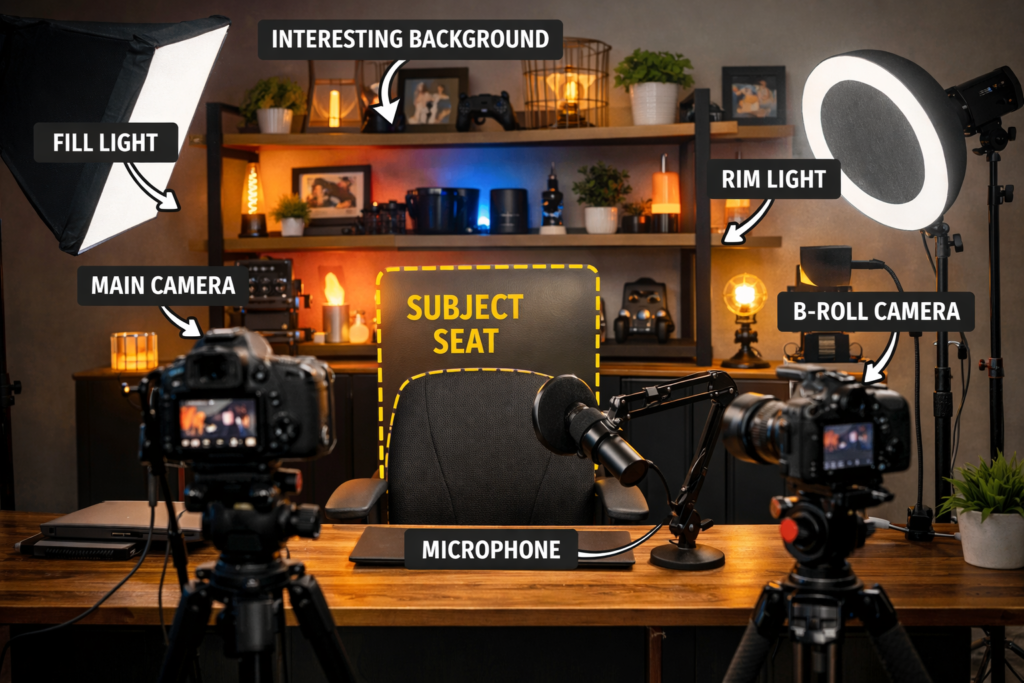
Studio Setup Overview
Three‑Point Lighting System A traditional three‑point lighting arrangement is used to ensure the subject is evenly illuminated and visually separated from the background. As your document notes, this setup “shows a classic setup to ensure the subject is well-lit and separated from the background.”
- Key Light: The main light source, placed front‑right, providing the strongest illumination on the subject.
- Fill Light: Positioned front‑left to soften and balance the shadows created by the key light.
- Back (Rim) Light: Located behind the subject to create a subtle outline along the hair and shoulders, adding depth and separation.
Dual‑Camera Configuration To offer multiple viewing angles and enhance production quality, the setup uses two cameras:
- Primary Camera: Placed directly in front of the subject for main on‑camera communication.
- Secondary (B‑Roll) Camera: Mounted on a side tripod to capture alternate angles, close‑ups, and supplemental footage. Your document describes this as being used “to capture alternative angles and close-up details.”
Audio Capture A high‑quality broadcast microphone is mounted on an articulated boom arm and positioned just outside the main camera’s frame. This placement ensures clean, professional‑grade audio while keeping equipment visually unobtrusive.
Background & Visual Interest The subject’s seating position is clearly defined behind the desk, and the background is intentionally designed to add depth and personality. As noted in your document, the backdrop includes “acoustic foam panels, LED strip lighting, and a display shelf with personal and technical props” to create a visually engaging livestream environment.
Buying and Using Webcams and Mirrorless Cameras for Livestreaming
FAQ
What is the difference between a webcam and a mirrorless camera for streaming?
A webcam is a compact camera designed specifically for computers and video calls. It connects directly via USB and works immediately with streaming software.
A mirrorless camera is a higher-end camera designed for photography and video. When used for livestreaming, it connects through an HDMI capture card and delivers significantly better image quality, depth of field, and low-light performance.
For most beginners, webcams are easier and cheaper. Mirrorless cameras are typically used by professional streamers or creators who want cinematic image quality.
Are webcams good enough for livestreaming?
Yes. Modern webcams are more than capable of producing high-quality livestreams, especially models that record in 1080p or 4K.
Popular webcams like the Logitech Brio 4K Webcam or Elgato Facecam provide excellent clarity, good autofocus, and simple plug-and-play setup. For streaming on platforms like Twitch, YouTube, or Discord, a quality webcam combined with good lighting often produces professional results.
Why do some streamers use mirrorless cameras?
Mirrorless cameras provide several advantages for livestreaming:
• Larger image sensors for better image quality
• Better performance in low light
• Interchangeable lenses for creative shots
• Cinematic background blur (bokeh)
Popular streaming cameras include the Sony ZV‑E10 Mirrorless Camera, Sony Alpha a6400 Mirrorless Camera, and Canon EOS R50 Mirrorless Camera.
These cameras are often used by professional streamers, educators, and YouTubers who want a more polished look.
What equipment do I need to use a mirrorless camera for streaming?
To use a mirrorless camera as a webcam, you usually need:
• The camera itself
• A clean HDMI output (See below,)
• An HDMI cable
• A capture card like the Elgato Cam Link 4K
• A tripod or mount
• Continuous power adapter (dummy battery)
Once connected, your computer recognizes the camera as a video source inside streaming software.
What is the best resolution for livestreaming?
For most livestreams, 1080p (Full HD) is the best balance of quality and performance.
While some webcams support 4K streaming, many platforms compress video heavily. Because of this, most creators stream at:
• 720p for low bandwidth
• 1080p for most professional streams
Platforms like Twitch often recommend 1080p at 30fps or 60fps depending on your internet speed.
Is lighting more important than the camera?
Yes. Lighting often matters more than the camera itself.
Even an expensive camera will look poor in bad lighting. A simple LED panel or ring light can dramatically improve image quality by:
• Reducing video noise
• Improving skin tones
• Creating sharper images
Many successful streamers invest in lighting before upgrading cameras.
Do I need a capture card for a webcam?
No. Webcams connect directly to your computer through USB and appear automatically in streaming software.
Capture cards are only required when connecting external cameras, game consoles, or DSLR/mirrorless cameras through HDMI.
What software do streamers use with webcams or cameras?
The most popular streaming software includes:
• OBS Studio
• Streamlabs Desktop
• XSplit Broadcaster
These programs allow streamers to add overlays, switch scenes, mix audio, and broadcast to multiple platforms.
Can I blur the background with a webcam?
Some webcams support digital background blur using software or AI features.
However, true cinematic background blur is usually achieved with mirrorless cameras because their larger sensors and lenses create natural depth of field.
What internet speed do I need for livestreaming?
A stable internet connection is essential.
Typical upload speed recommendations:
• 5 Mbps for 720p streaming
• 8–10 Mbps for 1080p streaming
• 15 Mbps or higher for high-quality streams
Wired Ethernet connections are usually more stable than Wi-Fi.
Is autofocus important for livestreaming?
Yes. Good autofocus ensures the camera keeps your face sharp even if you move during the stream.
Many modern cameras and webcams include face tracking autofocus, which automatically follows your face during the broadcast.
What is the best beginner setup for streaming?
A simple beginner livestream setup might include:
• A quality webcam like the Logitech C920 HD Pro Webcam
• A USB microphone
• Basic LED lighting
• Streaming software like OBS Studio
This setup is affordable, easy to install, and capable of producing professional-looking streams.
Should I upgrade from a webcam to a mirrorless camera?
Upgrade when:
• You want higher production quality
• You produce regular livestream or YouTube content
• Your channel is monetized or growing
For casual streaming or gaming, a good webcam is often more than enough.
Tip for streamers: Before upgrading your camera, improve your lighting, audio, and background. These upgrades often make a bigger difference than camera resolution alone.
What is “Clean HDMI Output” on a Mirrorless Camera?
Clean HDMI output means your camera sends a video signal without any on-screen graphics through the HDMI port. The image contains only the video from the sensor — no menus, icons, battery indicators, focus boxes, or recording timers.
When you connect the camera to a capture device like the Elgato Cam Link 4K, your computer receives a pure video feed, making it suitable for livestreaming or recording.
Without clean output, the livestream might show distracting overlays such as:
• Battery icons
• Focus squares
• Recording timers
• Camera settings
• Face detection boxes
Clean HDMI removes all of these elements so viewers only see the camera image.
Why Clean HDMI Matters for Livestreaming
Clean output is essential for professional-looking streams. It ensures that software like OBS Studio or Streamlabs Desktop receives a broadcast-ready video feed.
Benefits include:
• Professional video appearance
• No distracting camera overlays
• Easier integration with streaming software
• Higher perceived production quality
Many content creators rely on mirrorless cameras specifically because they can deliver this clean signal.
Do All Mirrorless Cameras Support Clean HDMI?
No. Older or entry-level cameras sometimes send HDMI video with overlays permanently visible.
Fortunately, most modern streaming-friendly cameras include clean output, including:
• Sony ZV-E10 Mirrorless Camera
• Sony Alpha a6400 Mirrorless Camera
• Canon EOS R50 Mirrorless Camera
Before purchasing a camera for streaming, it’s always wise to confirm clean HDMI output in the specifications.
How to Enable Clean HDMI Output
The exact steps vary by manufacturer, but the process usually involves:
- Opening the camera’s HDMI settings menu
- Turning HDMI Info Display or Display Overlays OFF
- Connecting the camera via HDMI to a capture device
Once connected, your computer will recognize the camera as a video source.
What Happens After You Enable Clean HDMI?
After connecting the camera through a capture card, your streaming software treats it like a webcam.
For example, in OBS Studio you simply:
- Add a Video Capture Device
- Select your capture card
- Adjust resolution and frame rate
Your mirrorless camera now acts as a high-quality livestream camera.
Clean HDMI vs USB Webcam Mode
Some modern cameras offer USB webcam mode, which lets them connect directly to a computer without a capture card.
However, HDMI with clean output often provides:
• Higher video quality
• More stable video signal
• Better compatibility with capture cards
This is why many professional streamers still use HDMI connections.
Quick Tip: When shopping for a streaming camera, look for the terms “Clean HDMI Output,” “HDMI Info Display Off,” or “Uncompressed HDMI Output.” These indicate the camera can produce a clean feed suitable for livestreaming.